Mastering sprint retrospectives: Sample answers and practical tips
If you work according to the Scrum process or want to learn from it, then sprint retrospectives are probably one of the most important components. They offer development teams the opportunity to come together regularly (usually around every two weeks at the end of the sprint) and reflect on the work of the last few weeks. This reflection makes it possible to categorize what has been experienced and to learn from it for the future. This makes it possible to strengthen the dynamics in the team in the long term and makes the team structure more effective.
The importance of honest feedback
and how to get it:
Tips for promoting open communication
Honest feedback is one of the absolute foundations for effective teamwork. Especially when you value continuous improvement. In my opinion, holding a good sprint retrospective only makes sense if a certain degree of openness is guaranteed. To ensure that honest feedback is given in sprint retrospectives, it is therefore important that the team members feel really safe. The more “fear” the team members feel of being judged, the less productive retrospectives and other feedback discussions will be. Therefore, here are some pragmatic tips for increasing psychological safety:
Create a relaxed and trusting environment:
-
- Easier said than done, the atmosphere is of course an important factor influencing the feeling of safety. Pay attention to the dynamics of how difficult situations are dealt with in the team. If you notice that the whole team tends to get stressed in these situations, this is a sign that there is too little “basic trust” in the team. Because when tensions are experienced in difficult situations, it usually automatically follows that people shy away from addressing sensitive topics because they don’t want to show the feeling in the team that is otherwise perceived in these situations. Relaxation and trust must therefore become the team’s modus operandi.
The role model function of managers (lead by example):
-
- Even though managers often want to act as equals with their teams, (especially inexperienced) team members take their cue from their manager: How does the manager deal with difficult situations?
As a manager, ask yourself when the last time was that you stood up in front of your team and said something like: “Guys, I’ve really fucked this up…”
If you reflect on this, it often happens less often than it should. If you as a manager feel shame yourself when dealing with problematic issues, it is not uncommon for this feeling to be transferred (albeit unconsciously) to the other members of the team.
You can take proactive countermeasures here, for example by taking the initiative in retrospectives when asked “What didn’t go so well” and dealing positively with your failures.
Anonymous feedback options:
-
- In working with many companies, we have found that the option of providing “anonymous feedback” often leads to things being addressed that would otherwise remain hidden. Even if the problem quickly arises that the feedback cannot be assigned to a person and therefore seems worthless at first, it can nevertheless raise awareness of the underlying problem.
Only when this awareness is present can you ensure, as in steps 1 and 2, that you question again why this feedback was only given anonymously.
All in all, it’s fair to say that fostering a culture characterized by safety and trust is no walk in the park. But understanding how this culture works and then cultivating it in the team over time is a real game changer.
You can also get another tip from Engineering Lead Jean-Sebastian Carle, who will help you to prevent very silent retrospectives. Take a look at our video:
Sample retrospective questions and answers
Now it makes sense to focus on the sprint retrospectives. Questions are asked here that are intended to stimulate thought and reflection:
The What Went Well retrospective
What went well Retro 👍: How the retro works
-
Random Icebreaker (2-5 minutes)
Echometer provides you with a generator for random check-in questions.
-
Review of open actions (2-5 minutes)
Before starting with new topics, you should talk about what has become of the measures from past retrospectives to check their effectiveness. Echometer automatically lists all open action items from past retros.
-
Discuss retro topics
Use the following open questions to collect your most important findings. First, everyone does it themselves, covered. Echometer allows you to reveal each column of the retro board individually in order to then present and group the feedback.
- What went well?
- What went not so well?
- How can we improve?
-
Catch-all question (Recommended)
So that other topics also have a place:
- What else would you like to talk about in the retro?
-
Prioritization / Voting (5 minutes)
On the retro board in Echometer, you can easily prioritize the feedback with voting. The voting is of course anonymous.
-
Define actions (10-20 minutes)
You can create a linked action via the plus symbol on a feedback. Not sure which measure would be the right one? Then open a whiteboard on the topic via the plus symbol instead to brainstorm root causes and possible measures.
-
Checkout / Closing (5 minutes)
Echometer enables you to collect anonymous feedback from the team on how helpful the retro was. This creates the ROTI score ("Return On Time Invested"), which you can track over time.
What went well Retro 👍

As seen in the chart, there are the following two, or in our case three, questions of the What Went Well Retrospective…👀
What went well?👍🏽
✅ Example: You were very happy with the new tool to help with prioritization & transparency of the product backlog. It should definitely be used further.
What didn’t work so well? 👎🏽
✅ Example: It’s good to look at agile metrics like your team’s velocity from time to time – Unfortunately, that hasn’t happened much lately! We should get better at keeping track of our metrics.
👉🏽 More info about: “ agile metrics %E2%80%9C.
How can we improve? 🙌🏽
✅ ExampleYou have the feeling that not everyone in your team dares to speak up. So the so called “psychological safety” should be improved. So you could do more often an agile team Health Check in 3 steps in the team.
👉🏽 More info about: “ psychological safety %E2%80%9C or “ Team health check in 3 steps %E2%80%9C.
Further resources and templates
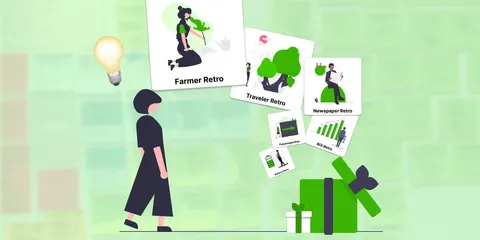
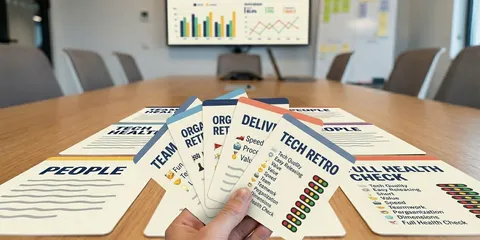
Of course, we also have other retrospectives on offer. Here are a few examples:
Sprint retrospective sample answers
Team Commitments Retrospective
The current challenges require exceptional teamwork. Check whether your team is pulling together with this retro:
🤝Retro for reflecting and defining team commitments: How the retro works
-
Random Icebreaker (2-5 minutes)
Echometer provides you with a generator for random check-in questions.
-
Review of open actions (2-5 minutes)
Before starting with new topics, you should talk about what has become of the measures from past retrospectives to check their effectiveness. Echometer automatically lists all open action items from past retros.
-
Health Check
All team members can answer the health checks anonymously on a scale. Then go through the results of the health checks together and record any additional comments if necessary. If you use the same health checks in several retrospectives, you can also track trends over time in Echometer.
- As a team, we share a common understanding of what "good work" is.
-
Discuss retro topics
Use the following open questions to collect your most important findings. First, everyone does it themselves, covered. Echometer allows you to reveal each column of the retro board individually in order to then present and group the feedback.
- Handling of contradictory priorities: ‘When I encounter contradictory priorities, I …’
- Communication of blockers: ‘When I am stuck on a task, I announce this by …’
- Navigation of conflicts: ‘When I notice a conflict start to build up in our team, I …’
-
Catch-all question (Recommended)
So that other topics also have a place:
- What else would you like to talk about in the retro?
-
Prioritization / Voting (5 minutes)
On the retro board in Echometer, you can easily prioritize the feedback with voting. The voting is of course anonymous.
-
Define actions (10-20 minutes)
You can create a linked action via the plus symbol on a feedback. Not sure which measure would be the right one? Then open a whiteboard on the topic via the plus symbol instead to brainstorm root causes and possible measures.
-
Checkout / Closing (5 minutes)
Echometer enables you to collect anonymous feedback from the team on how helpful the retro was. This creates the ROTI score ("Return On Time Invested"), which you can track over time.
🤝Retro for reflecting and defining team commitments
Health Check Questions (Scale)
Open questions

Sprint retrospective sample answers
Psychological safety Retro
Especially in tough times, low-conflict collaboration is crucial. But for this to happen, everyone must also dare to talk about points of friction before they escalate. Having the security in the team to be able to express oneself at all times is also known as “psychological safety”. See how things stand with you on this topic:
Psychological safety Health Check: How the retro works
-
Random Icebreaker (2-5 minutes)
Echometer provides you with a generator for random check-in questions.
-
Review of open actions (2-5 minutes)
Before starting with new topics, you should talk about what has become of the measures from past retrospectives to check their effectiveness. Echometer automatically lists all open action items from past retros.
-
Health Check
All team members can answer the health checks anonymously on a scale. Then go through the results of the health checks together and record any additional comments if necessary. If you use the same health checks in several retrospectives, you can also track trends over time in Echometer.
- I regularly receive useful feedback on how good my performance is and how I can improve.
- If a team member makes a mistake, they are not judged for it.
- You're allowed to not know things in our team.
- In conflicts, we talk on a factual level, so that no one feels personally attacked or judged.
-
Discuss retro topics
Use the following open questions to collect your most important findings. First, everyone does it themselves, covered. Echometer allows you to reveal each column of the retro board individually in order to then present and group the feedback.
- What else do we want to talk about?
-
Catch-all question (Recommended)
So that other topics also have a place:
- What else would you like to talk about in the retro?
-
Prioritization / Voting (5 minutes)
On the retro board in Echometer, you can easily prioritize the feedback with voting. The voting is of course anonymous.
-
Define actions (10-20 minutes)
You can create a linked action via the plus symbol on a feedback. Not sure which measure would be the right one? Then open a whiteboard on the topic via the plus symbol instead to brainstorm root causes and possible measures.
-
Checkout / Closing (5 minutes)
Echometer enables you to collect anonymous feedback from the team on how helpful the retro was. This creates the ROTI score ("Return On Time Invested"), which you can track over time.
Psychological safety Health Check
Health Check Questions (Scale)
Open questions

Sprint retrospective sample answers
Battery Retrospective
Difficult times also put a strain on personal batteries. It is particularly important now to keep an eye on the team’s energy levels:
Battery retrospective: How the retro works
-
Random Icebreaker (2-5 minutes)
Echometer provides you with a generator for random check-in questions.
-
Review of open actions (2-5 minutes)
Before starting with new topics, you should talk about what has become of the measures from past retrospectives to check their effectiveness. Echometer automatically lists all open action items from past retros.
-
Discuss retro topics
Use the following open questions to collect your most important findings. First, everyone does it themselves, covered. Echometer allows you to reveal each column of the retro board individually in order to then present and group the feedback.
- How full is your personal battery as a percentage right now?
- What has drained your battery recently?
- What has recharged your battery recently?
- What would help you to save energy over the next few weeks?
-
Catch-all question (Recommended)
So that other topics also have a place:
- What else would you like to talk about in the retro?
-
Prioritization / Voting (5 minutes)
On the retro board in Echometer, you can easily prioritize the feedback with voting. The voting is of course anonymous.
-
Define actions (10-20 minutes)
You can create a linked action via the plus symbol on a feedback. Not sure which measure would be the right one? Then open a whiteboard on the topic via the plus symbol instead to brainstorm root causes and possible measures.
-
Checkout / Closing (5 minutes)
Echometer enables you to collect anonymous feedback from the team on how helpful the retro was. This creates the ROTI score ("Return On Time Invested"), which you can track over time.
Battery retrospective

You can also read through this article, where we have presented 33 more retros: 33 Simple examples of retrospectives
Of course, it also makes sense not to simply make retros, but to use a tried and tested structure in the retrospectives.
This is exactly why we created the Echometer tool. It allows you to prepare a perfect retrospective in under 2 minutes. More than 100 customers already describe this as a huge lever for their retro management.
Just try it out for free: